
Home / Articles / Human art and AI
Human art value in the AI era
The mass arrival of generative artificial intelligence has radically transformed the visual landscape. Today it is possible to generate thousands of complex images in seconds from a text prompt.
In this new context of synthetic abundance, the art market is undergoing a deep shift: what is truly valuable again is the human mark, the studio process, and tamper-resistant physical authorship.
This is not about rejecting digital tools. It is about being able to show, with catalog, seal, certificate, and verification, that behind a piece there is an author, a studio, and a date that cannot be rewritten at convenience.
Updated: August 8, 2026
The abundance paradox: why human art is rising in value
When synthetic images become infinite and cheap, the interest of collectors, galleries, and demanding buyers no longer centers on the visual result alone, but on the provenance of the object:
- Is there a real person behind the work, with a trajectory and a vision of their own?
- Is there a physical creation process (pigments, brushstrokes, matrix, sculpture, sketch preparation)?
- Can you prove the exact date when the artist conceived and finished the piece?
Without transparent certification that documents human creation and the studio, any work risks being confused with a synthetic image in catalogs or digital galleries. Beauty stops being the only filter: traceability becomes part of the value.
Checklist to prove human authorship (without empty talk)
Before talking about “human art,” make sure you can show concrete evidence:
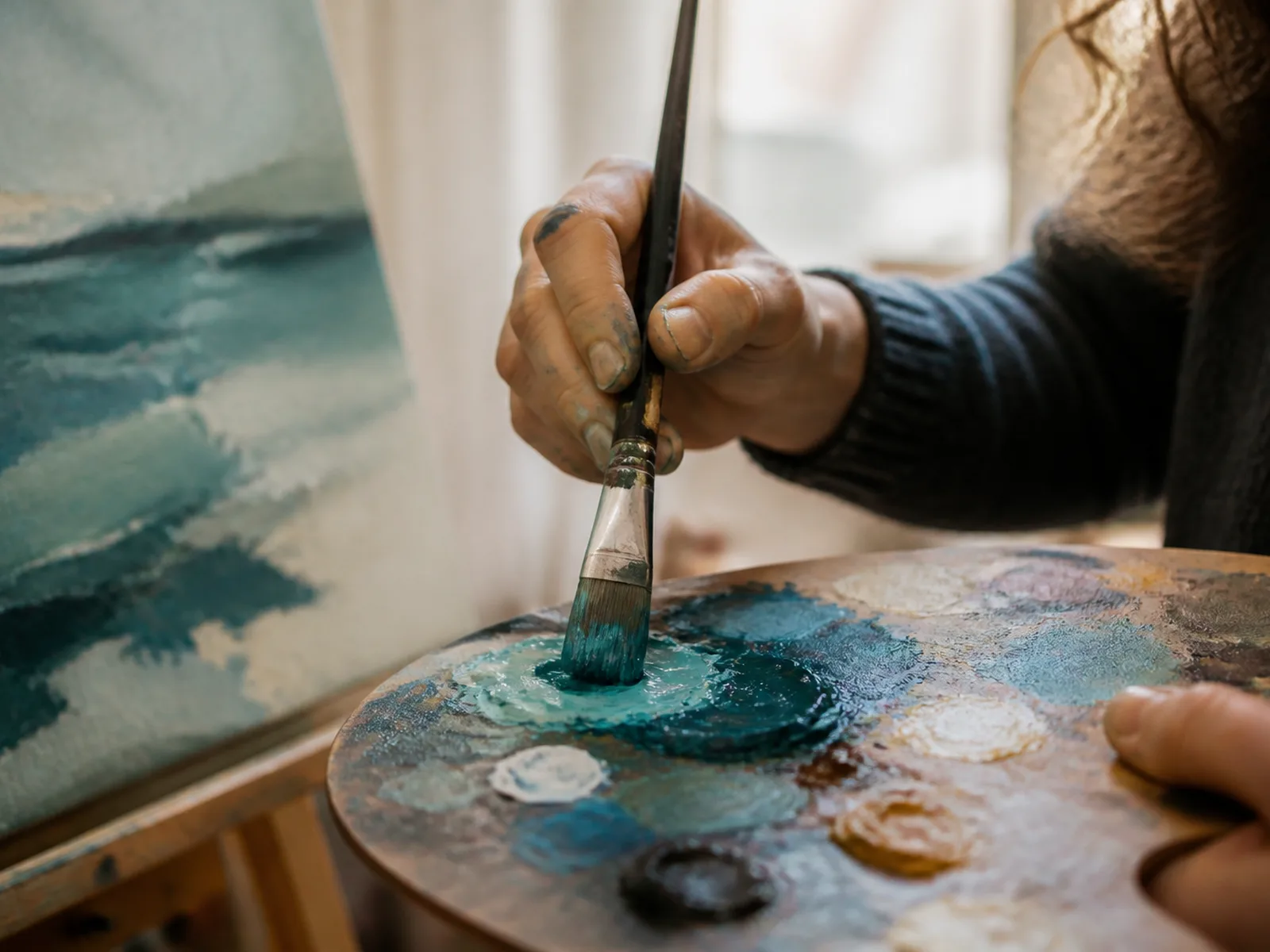
- Documented studio process: sketches, layers, color proofs, armatures, molds, or in-progress captures.
- Complete technical sheet in the catalog: title, year, technique, materials, dimensions, and a description consistent with the piece.
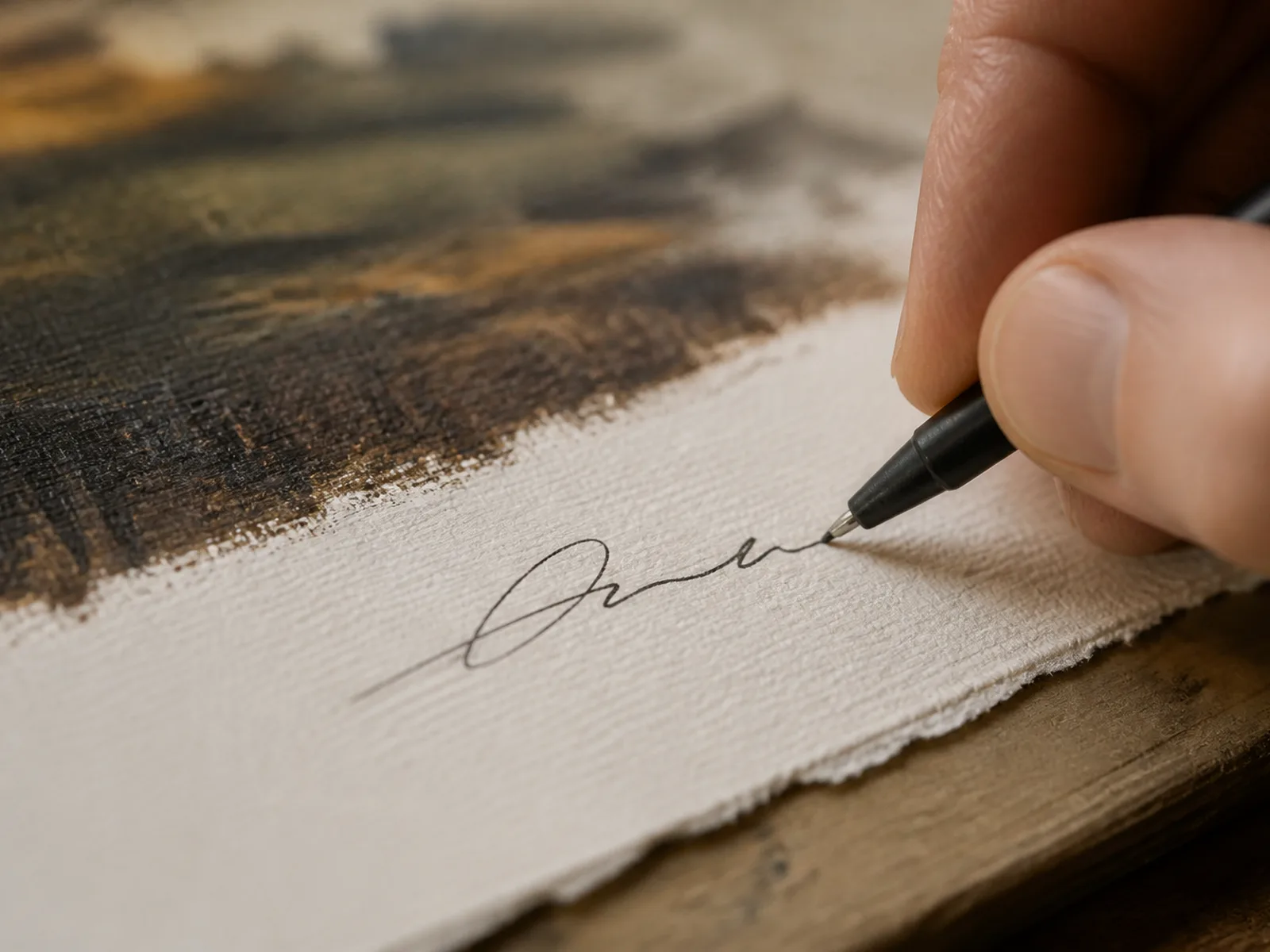
- Visual record of the physical work: front, texture or signature details, and reverse or base when relevant.
- Seal linked to the matter: an inviolable mark on the piece or on its conservation certificate.
- Certificate with verification: a link or QR that lets anyone check the record without opaque intermediaries.
- Notarized timestamp: blockchain as a notary of integrity, not as speculative fashion.
- Clear tool declaration: if there was partial digital assistance, describe it; opacity creates suspicion.
If all you have is a final JPG and a biography, you do not have proof of human authorship: you have one more image in an ocean of images.
Typical mistakes when “defending yourself” from AI
- Relying only on a recognizable style. Styles can be imitated; provenance cannot.
- Publishing process photos on social media and not archiving them in the catalog. What lives only on Instagram disappears from the commercial history.
- Certifying late, once doubt already exists. A timestamp is worth more the earlier it is fixed.
- Hiding digital tools in mixed-media works. Declaring the real workflow is better than looking evasive.
- Handing over a generic PDF with no verification. An editable document does not distinguish your painting from a downloaded render.
- Thinking a philosophical debate replaces the seal. Collectors care about being able to check the piece.
How to demonstrate and certify the human authorship of your work
Protecting your work against AI saturation does not require complex philosophical debates, but professional documentation practices:
- Document the studio process: Keep images of sketches, early layers, material mixes, or work on the canvas.
- Specify a complete technical sheet: Detail the traditional or mixed techniques used and the production date.
- Seal the physical piece: Place an inviolable Uniiku physical seal on the physical work to link the real matter with its tamper-resistant record.
- Register the timestamp: Blockchain technology acts as an impartial notary proving that the data and studio images existed on a specific date.
Order matters: catalog and evidence first; then seal and certificate. That way verification points to a solid history, not an improvised record.
Criteria a collector (or gallery) should require
When someone says “this work is human,” these questions separate marketing from proof:
- Can I see the record in a stable catalog, not only in a post?
- Is there a seal or conservation support associated with this piece?
- Does the certificate include technique, dimensions, and comparable images?
- Does verification work without installing apps or wallets?
- Is there a registration date that does not depend on the artist’s Word file?
If the answer is no on two or more points, the buyer is accepting a promise, not a guarantee.
Mini-case: the series that “looked like AI”… until the studio appeared
A mixed-media artist published a series of canvases with very clean finishes. Online, several comments insisted it was “definitely AI.” Visually, the doubt was understandable: the composition was precise and the color tightly controlled.
Instead of arguing in comments, the artist opened the catalog: uploaded photos of grounds, intermediate layers, and the signed reverse of each piece. Certified the three main works with a seal on the stretcher and left verification accessible by QR. When a collector visited the studio, they compared the real texture with the process images and checked the certificate on their phone.
The conversation shifted from “is it AI?” to “which one do we reserve?” Traceability won, not the aesthetic debate.
Certification as a competitive advantage for independent artists
For independent artists, being able to show a collector a certificate with a tamper-resistant date and studio traceability is the strongest guarantee of professionalism.
This is not about attacking technology, but about reclaiming the value of craft, aesthetic intention, and human dedication. In a market saturated with perfect images, the differentiator is not only painting better: it is being able to prove that the work exists, who made it, and when it was fixed in a verifiable record.
The catalog organizes; the seal links; the certificate communicates; verification closes trust. Blockchain, used as a notary, supports the integrity of that chain without turning the buyer into a cryptocurrency user.
Related articles
Frequently asked questions
Can I certify works that combine traditional techniques with digital tools?
Yes. In Uniiku’s technical sheet you can describe exactly the mixed techniques used, attaching images of the creative process and the physical layers.
How does Uniiku help differentiate my work from AI-generated content?
Uniiku links the real physical piece to a record with a tamper-resistant timestamp, detail photographs, and studio documentation that no generative AI can impersonate.
Do I need to register the full process for every work?
You do not need a cinematic making-of. With a few key studio proofs, a complete record, and, when relevant, a seal and verifiable certificate, you already offer a serious basis for human authorship.
Reclaim the value of your human creation
Protect the history of your works and give buyers irrefutable proof of authorship.