
The certificate as an invisible identity document
Imagine trying to travel without a passport or sell a vehicle without a technical sheet. The object is present, but missing documentation blocks the transaction.
In the art world the same thing happens. A certificate of authenticity works as the artwork’s ID: it identifies authorship, technical data, and the link to the physical piece.
Even when the artist is still alive, selling without a certificate creates hesitation among experienced collectors, auction houses, and insurers. It is not enough that the work exists; the market asks for a consultable proof of its identity.

Risks of relying on loose papers
For decades, certificates of authenticity have been signed letters on loose sheets, cardboard cards, or commercial stickers. Those traditional formats share three major weaknesses:
- They get lost in moves, storage, or inheritance.
- They can be forged, altered, or photocopied easily.
- They often detach from the physical piece they were meant to protect.
A loose paper certificate that is not fixed by a physical fingerprint or a timestamped digital register loses much of its protective value over time. The buyer inherits a fragile document, not a verifiable identity.
The contemporary solution: a physical–digital bond
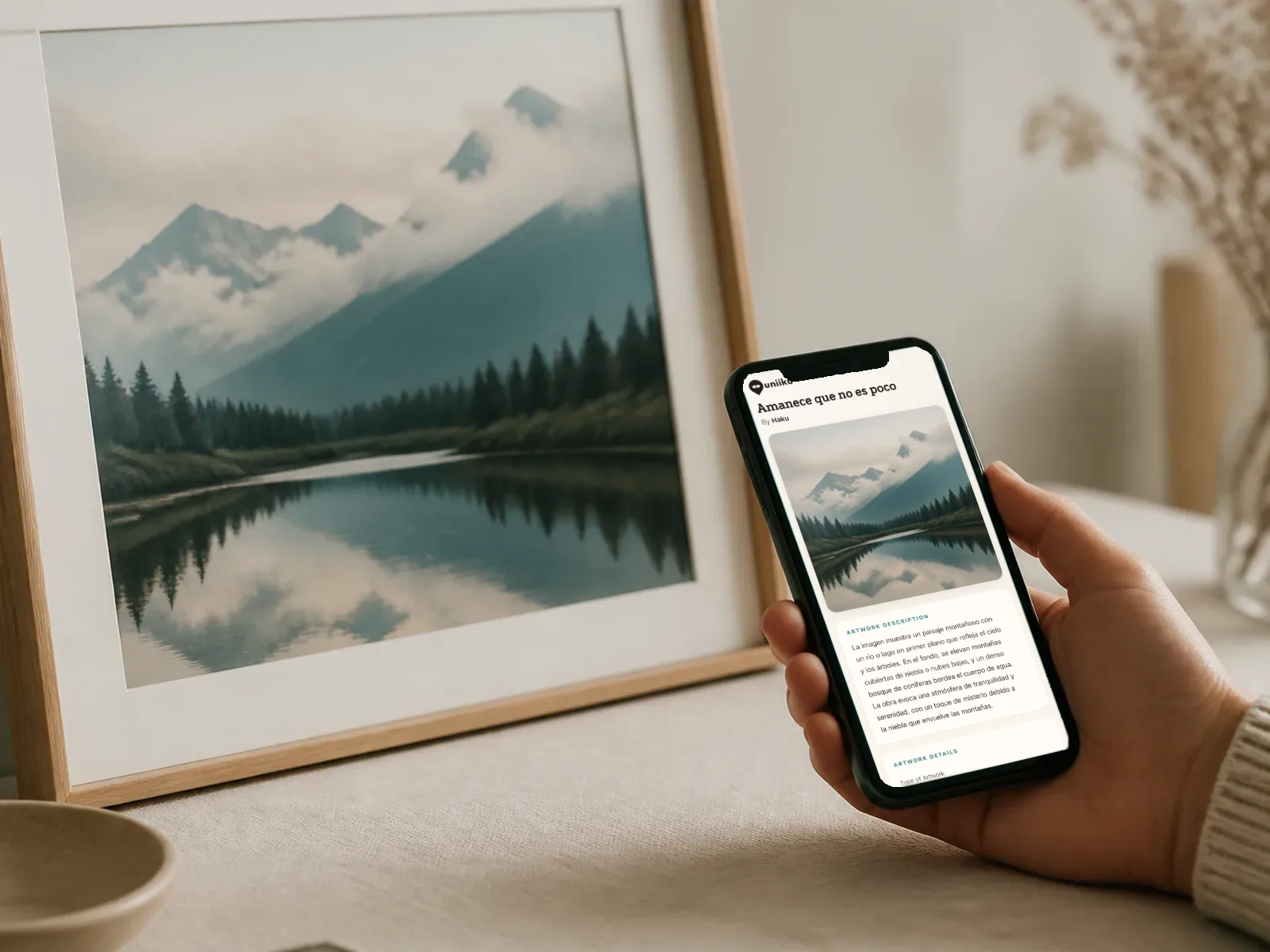
The modern standard points to a certificate that is physically connected to the work and digitally custodied with a registration date.
With Uniiku, the certificate stops being a document forgotten in a drawer. It becomes a consultable register, backed by blockchain technology and accessible by scanning the physical seal.
Offering that security to the buyer does not only protect the piece: it raises the artist’s perceived professionalism and eases future resale, donation, or insurance. Learn how to prove provenance without a gallery.
That physical–digital bond also simplifies the sales conversation. Instead of sending loose screenshots or hard-to-verify PDFs, you can show a living record linked to the work. The collector understands what they are buying; you show that your studio archive is in order.
Checklist before delivering a certified artwork
Before you close the sale or shipment, review:
- Complete technical record: title, year, dimensions, support, technique, and a short description consistent with the real work.
- Clear photographs: front, verso, and a signature or texture detail so the visual register accompanies the certificate.
- Edition data (if applicable): copy number, total edition size, and artist’s proofs declared clearly.
- Seal or physical link: the certificate should attach to the specific piece, not only to a generic PDF.
- Verifiable access for the buyer: a link or scan that lets them consult the record without depending on a paper that can be lost.
Completing this list does not turn the certificate into an absolute legal guarantee, but it does reduce friction and shows professional rigor from first contact. If a detail is missing, fix it before shipping rather than improvising after the sale.
Treating the certificate as part of delivery—not as a last-minute add-on—is what lets the work enter the market with a clear, consultable identity.
Related articles
Frequently asked questions about certificates of authenticity
Can a digital certificate replace a paper document?
Yes—or it can complement a traditional paper certificate. What matters is a dated integrity proof that nobody can alter afterward.
What if a collector loses the printed certificate?
Because it is tied to the Uniiku seal and registered on the blockchain, the digital certificate can be consulted by scanning the physical piece, avoiding permanent loss of the history.
Give your artworks a lasting identity
Create verifiable certificates in minutes and protect the future value of your work.