
Home / Articles / Fine Art photography
Certify fine art photography: editions, artist proofs, and catalog records
Protecting an artist print is more than a pencil signature. It means giving the collector a clear edition size, the exact giclée process, and a verifiable identity for that copy. In Fine Art photography, the digital file can be reproduced endlessly; market value comes from the discipline with which you edit, print, number, and certify each print.
Updated: September 6, 2026
Protecting an artist print is more than a pencil signature. It means giving the collector a clear edition size, the exact giclée process, and a verifiable identity for that copy. In Fine Art photography, the digital file can be reproduced endlessly; market value comes from the discipline with which you edit, print, number, and certify each print.
The reproducibility challenge in photography
Unlike an oil painting, a digital photo file can produce identical prints indefinitely. The economic and artistic value of a numbered author photograph rests on the photographer’s discipline: limiting the edition and certifying every copy.
Without durable traceability, a buyer or gallery may wonder whether print 3/10 is truly unique within the stated edition—or whether unregistered replicas exist. That doubt erodes secondary-market pricing and complicates insurance, inheritance, and resale.
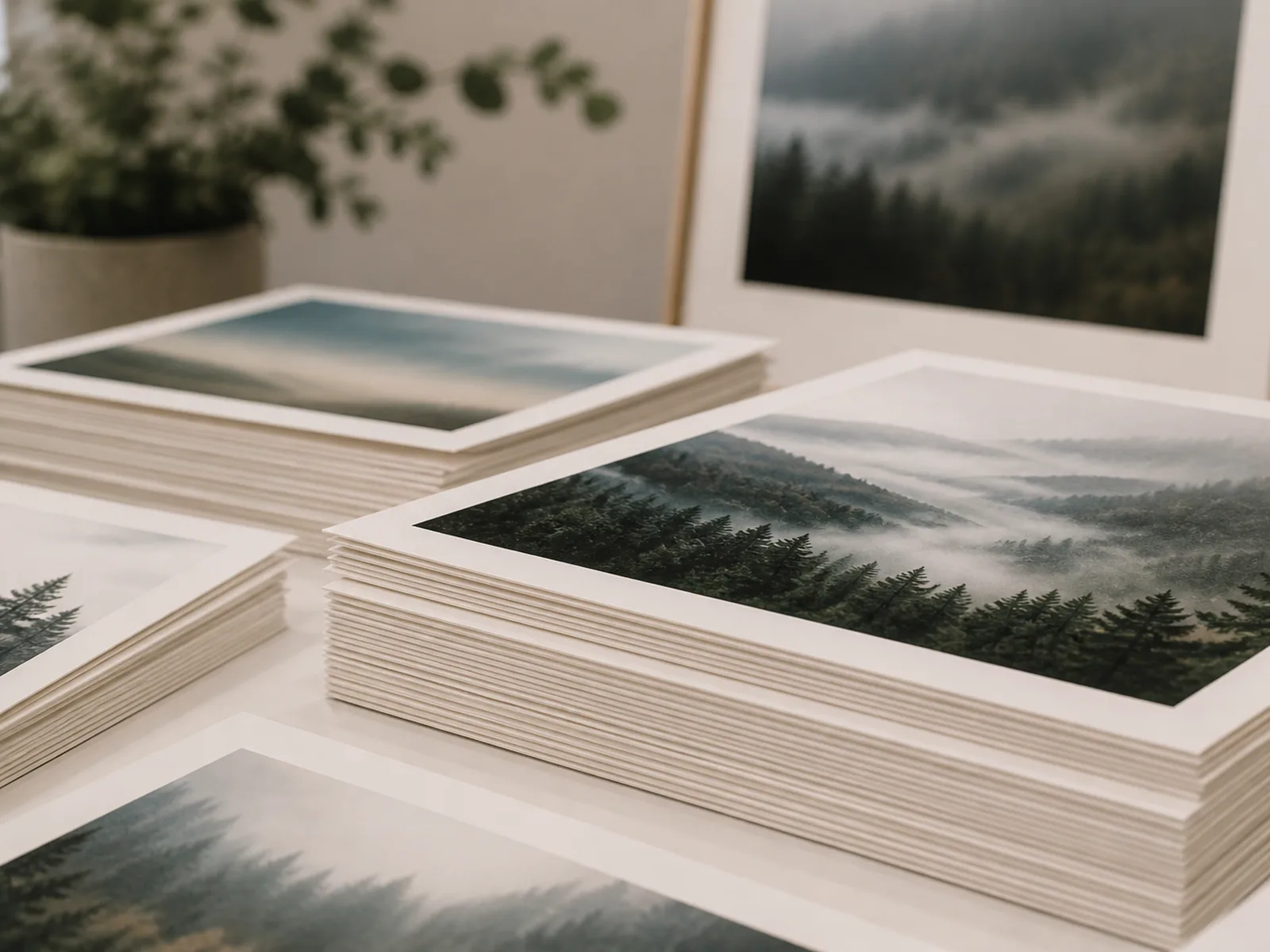
Essentials for a Fine Art catalog record
- Paper type: Cotton or alpha-cellulose conservation papers (e.g. Hahnemühle, Canson Infinity, Awagami).
- Inks: Pigment-based giclée printing built for archival durability.
- Numbering and Artist’s Proofs: Exact edition declaration (e.g. 1/15) and A/Ps when they apply.
- Conservation identifier: Print or output date and the lab or printer responsible.
- Print size vs. image size: Distinguish full sheet from image area when margins are part of the presentation.
- Finish and mounting: Loose, with mat, mounted on dibond, varnished, or encapsulated.
The more precise the record in your catalog, the easier it is years later to show exactly what the collector bought.
Checklist for fine art photographers
Before you put an edition on sale, check:
- Closed edition per title. Define how many copies exist for that size and support. If you sell 30×40 and 50×70 as separate editions, declare them separately.
- A/P and studio proof policy. Cap how many artist’s proofs or studio proofs exist; do not mix them into regular numbering.
- File → print consistency. Note color profile, lab, and paper; avoid two “identical” copies leaving different processes undocumented.
- Seal or certificate per copy. Each number (1/15, 2/15…) must be independently verifiable.
- Visual record of the print. Photograph the printed copy (not only the RAW file) and, when possible, the signed verso or mat.
- Certificate issue date. Blockchain as notary timestamps when that record was sealed—useful if someone later claims a different edition size.
Common mistakes in photographic certification
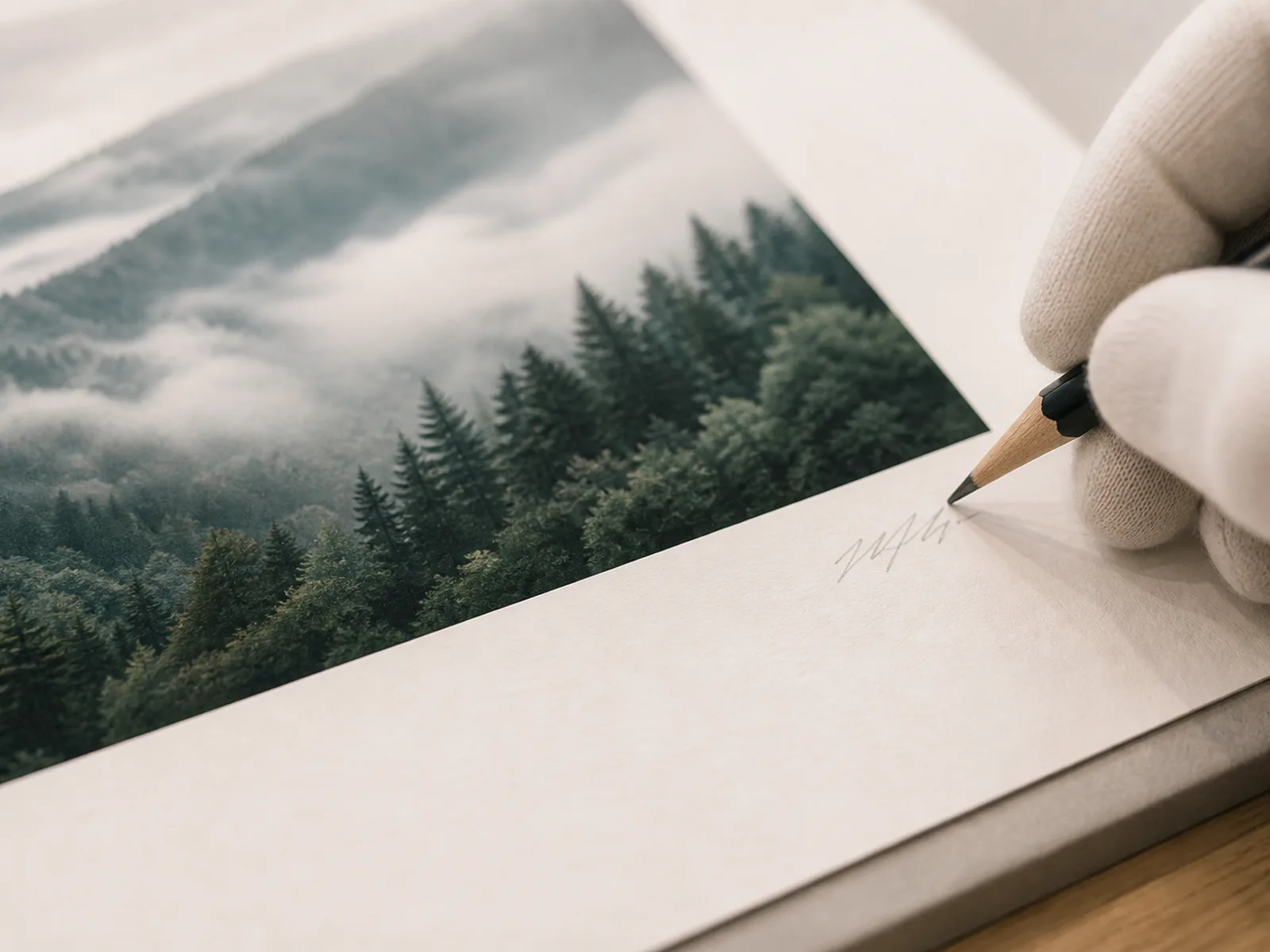
- Signing the mat and skipping the certificate. A pencil signature is useful tradition, but it is not enough if the paper is lost or the mounting changes.
- Calling it a “limited edition” without numbering each copy. Marketing language does not replace a registered 7/25.
- Reprinting “the same” edition years later on different paper. If you change support or lab, either close the previous edition or document a new edition with its own record.
- Handing over only a generic series PDF. The collector needs the identity of their copy, not a campaign description.
- Mixing open edition and limited edition without saying so. Commercial and documentary clarity: the catalog should show which is which.
Link the digital file to the printed copy
Signing in pencil on the mat or verso is common practice, but a separate printed certificate can be lost or copied.
When you attach a Uniiku seal to the physical print—or to the conservation board that travels with the frame—you create an unalterable digital fingerprint with a guaranteed date. If a buyer scans the verification code, they see the official technical record: paper details, the series registered in your studio inventory, and the certificate of authenticity.
The catalog centralizes the edition; the seal binds that record to the print on the wall; blockchain acts as notary so nobody rewrites the numbering after the fact.
What serious collectors look for
When an experienced buyer evaluates a Fine Art photo, they usually ask:
- Is the edition closed and verifiable?
- Are paper and inks archival—or consumer-grade?
- Can I check my copy’s number without calling the photographer?
- Do the website claim, the certificate, and the physical piece agree?
- Is there a history if the work changes hands?
Answering “yes” does not require a long technical speech: it requires a complete certificate, a verification seal, and an orderly catalog.
Mini-case: edition 8/12 nobody could prove
Luis sells a series of twelve giclée copies on baryta paper. He numbers the verso in pencil and sends a generic PDF: “Certificate of authenticity — Horizon Series.” Five years later, copy 8/12 reaches a secondary gallery. The new buyer asks for proof that no more than twelve exist. Luis no longer has the email list and cannot recall which lab printed each one.
If each copy had had its own record in the Uniiku catalog—with paper, print date, and physical seal—the gallery would have verified 8/12 in seconds. The mini-case is not an artistic failure; it is a traceability failure: without a per-copy register, the limited-edition promise is hard to defend.
Best practices when you expand or close an edition
If you have not sold every number yet, keep the series record visible and update each copy’s status (available, reserved, sold). If you close the edition before the quota is exhausted, document the closure in the catalog: a smaller, transparent edition beats an “official” edition the market cannot verify.
For new sizes or reprints on different paper, create a new edition. Do not reuse numbering from a previous series: collector trust depends on 1/15 always meaning the same thing.
Treat every size, paper, and finish as its own commercial promise. When the catalog, the seal, and the certificate all point to the same numbered copy, collectors can verify without guessing—and you can defend the edition years after the first sale.
Related articles
Frequently asked questions about photographic certification
How do you apply a Uniiku seal on a Fine Art photo print?
It is usually placed on the verso of the print or mat, or on a supplementary conservation-paper certificate that travels with the photo. What matters is that the seal stays with the copy and enables verification.
What if I print additional giclée copies later?
Each numbered copy in your series gets its own unique seal assigned in the digital catalog, so the declared numbering stays traceable. If you open a new edition or change support, document a distinct edition instead of reusing numbers already issued.
Should I also certify Artist’s Proofs?
Yes—preferably. A/Ps are part of the edition ecosystem. Registering them in the catalog with their own numbering avoids confusion and shows they are not uncontrolled “extra copies.”
Certify your author photographs today
Create artwork records in the free catalog and assign verifiable physical seals to your strongest editions.