
Home / Articles / Solid Certificate
What an authenticity certificate must include
Whether you are an artist who wants to issue impeccable documentation or a collector, gallerist, or private buyer, evaluating the strength of an authenticity certificate is crucial to avoid fraud and costly losses on the secondary market.
Updated: September 6, 2026
The end of editable printed paper
Whether you are an artist who wants to issue impeccable documentation or a collector, gallerist, or private buyer, evaluating the strength of an authenticity certificate is crucial to avoid fraud and costly losses on the secondary market.
Traditionally, certificates have been handwritten sheets or Word templates. In today’s market, that paper format is vulnerable to being lost, photocopied, or forged. A contemporary certificate must be consultable, linkable to the physical piece, and hard to alter after the fact.

Essential checklist for a solid certificate
For an authenticity certificate to have real documentary and traceability rigor, it should meet these minimum elements:
1. Tamper-resistant technical sheet of the work
- Artist name: Clear and complete identification.
- Title of the piece: Official title and version or subcriterion if any.
- Year and completion date: Year the work was started and finished.
- Technique and materials: Detailed specification (e.g. oil on linen canvas, 5-color screenprint on Arches paper).
- Exact dimensions: Height × Width (and Depth for sculptures) in centimeters.
- Edition numbering: For limited series, mandatory copy number (e.g. 12/50, A/P I/V).
2. High-definition visual record
The certificate should include sharp images of the complete work, with special attention to the artist’s signature, edges, or characteristic details of physical texture that allow the certificate to be compared with the real piece. Without a visual record, any textual sheet can be reassigned to a similar piece.
3. Irrefutable physical link
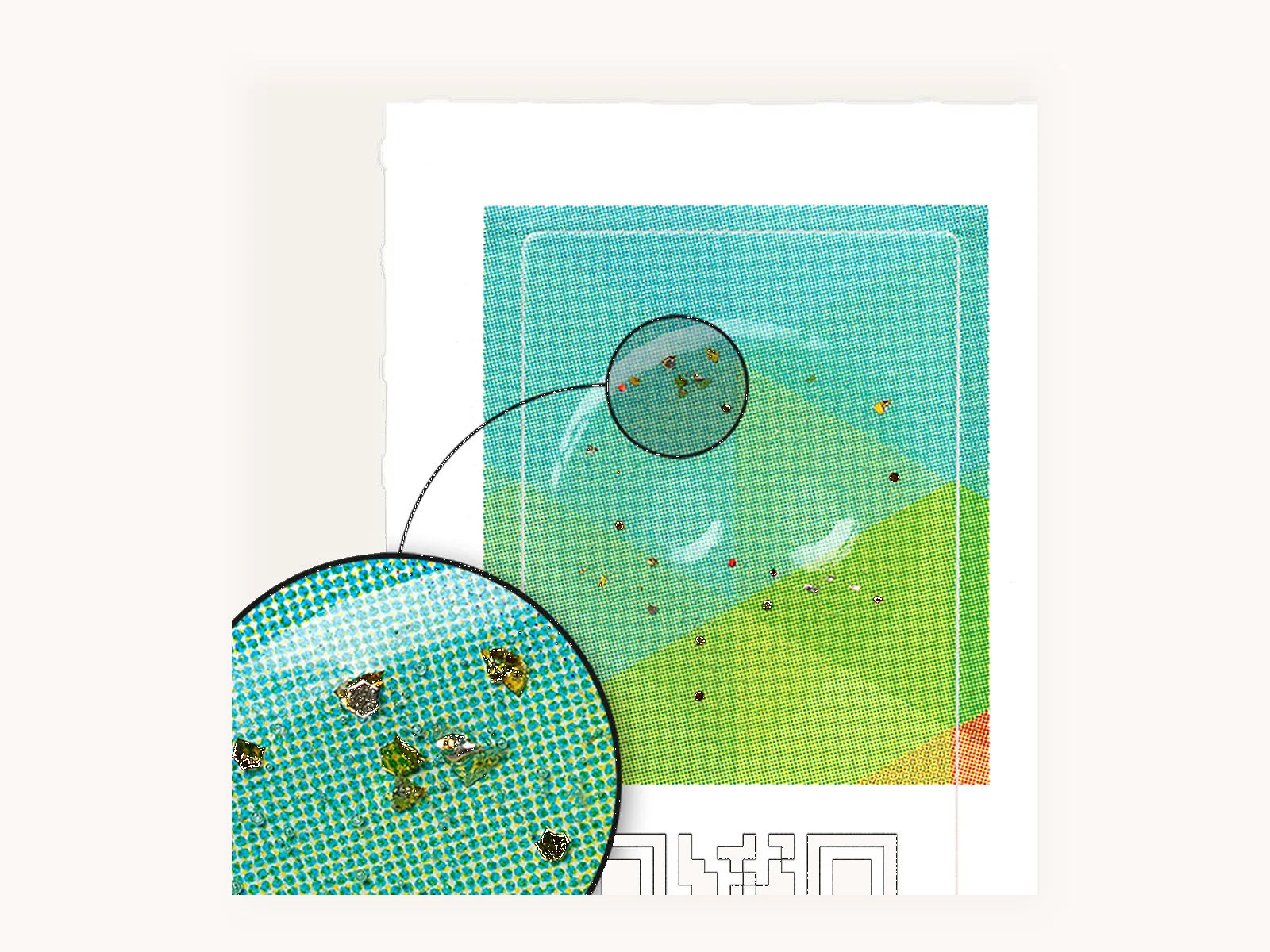
A loose printed sheet in an envelope does not prove it belongs to the work on the wall. A contemporary certificate should include non-transferable proof of physical linkage, such as a seal with a verification code affixed to the piece or its conservation support.
4. Immutability and timestamp
The certificate data should be sealed at the moment of issuance. Using blockchain as a digital notary ensures that no one (not even the issuer) can retroactively alter dimensions, year of creation, or edition size.
Practical criteria for artists, collectors, and galleries
Not every buyer evaluates a certificate at the same level of detail. These criteria help prioritize:
- Issuing artist: Can I regenerate or resend the certificate if the buyer loses it? Does the record remain in a consultable catalog?
- Collector or investor: Can I verify the piece without depending on the artist or an intermediary? Is there a sealed issuance date?
- Gallery or auction house: Is documentation consistent across works by the same artist? Is numbering clear on editions?
- Insurer or appraiser: Are photos, measurements, and technique precise enough to identify the piece in case of a claim?
A weak certificate usually fails on two points: it is not linked to the physical work, or its data can be edited without leaving a trace. If you are the artist who must issue the documentation, follow how to create a certificate of authenticity for your artwork.
Typical mistakes when issuing or accepting a certificate
- Using generic templates without unique data. A PDF with incomplete fields (no exact measurements, no photos, no edition number) does not serve as the piece’s identity.
- Handing over only the paper and not linking it to the work. If the certificate travels in one envelope and the work in another, the chain breaks at the first move.
- Declaring an edition without a per-copy record. Writing “edition of 50” without sheets for 1/50, 2/50… leaves the door open to duplicates.
- Trusting WhatsApp screenshots or loose invoices. They can help as commercial context, but they do not replace a certificate with verification and a timestamp.
- Promising absolute validity without nuance. A good certificate provides documentary and traceability proof; it does not by itself turn every dispute into an automatic court ruling.
Why PDF/Word templates are no longer enough
An editable template downloaded from the internet offers zero guarantees: anyone can alter the text with a PDF editor or print a duplicate copy for a fake work.
The standard that insurers, auction houses, and advanced collectors expect today is instant public digital verification by scan. With Uniiku, the record lives in the artist’s catalog, the seal links the physical piece, and blockchain acts as notary of the date and sealed content.
Mini-case: the collector who lost the paper
Ana buys a work at a fair. The artist gives her a well-written printed certificate, but with no physical seal or verification link. Three years later, when she moves, the paper disappears. When she wants to insure the piece, she only has photos from the artist’s Instagram and a bank statement.
If that same sale had included a Uniiku seal on the reverse and a catalog certificate with verification, Ana could scan the work, recover the record, and demonstrate authorship, issuance date, and technical data without depending on the lost paper. The value is not only in “having a PDF,” but in being able to verify the piece’s identity when it matters most.
What to require before buying or signing a sale
Quick checklist for the negotiation table:
- Complete technical data consistent with the piece you are looking at.
- Images that allow comparison of signature, reverse, or unique details.
- Clear numbering if it is a limited edition.
- A verification mechanism (code, seal, or public URL) that does not depend only on the issuer.
- A timestamp or register that prevents changing the record “backwards.”
- Confirmation that the certificate belongs to that physical copy, not a generic description of the series.
If any of these points is missing, ask for clarification before closing. It is cheaper to correct documentation at the time of sale than to reconstruct provenance years later.
Related articles
The certificate as ID
Why documentary identity determines commercial value.
Justify the price of your art
How solid authorship documentation supports economic value.
NFTs vs Physical Certificates
The difference between a speculative token and real certification of physical art.
QR, NFC, and hologram seals
What each marker covers, and what is not enough to authenticate.
Certificate providers compared
Uniiku, Verisart, Tagsmart, and DIY: price, issuer, marker, and resale.
Frequently asked questions
Does a Uniiku digital certificate serve as proof when selling a work?
Yes, as documentary and traceability proof: it attests to the authorship declaration, the sealed technical data, and the issuance date. Blockchain acts as digital notary of that information. It does not by itself replace an expert appraisal or guarantee the outcome of a specific legal proceeding; it provides a verifiable history that strengthens transaction transparency.
What happens if a buyer loses the paper certificate?
If the work has a Uniiku seal affixed, certification is not lost. By scanning the seal with any smartphone, the buyer can consult and download the official verified record again from the catalog.
Is a hand-signed PDF enough to consider the certificate complete?
A signed PDF can be a good complement, but on its own it usually fails on physical linkage and immutability. The ideal is to combine a complete technical sheet, visual record, verification seal on the piece, and a tamper-resistant timestamp.
Issue solid, tamper-resistant certificates
Create your professional catalog and give collectors the highest level of assurance.