
Home / Articles / NFTs vs Physical Certification
NFTs don’t protect a physical painting — seals do
During the boom of non-fungible tokens (NFTs), blockchain technology was promised as a revolution for the art market. For artists who paint in oil, sculpt, or produce physical editions, though, traditional NFTs turned out to be an incomplete solution disconnected from studio reality.
Blockchain can be an excellent notary. The mistake was treating it as a substitute for the object, instead of as the verification layer that proves the integrity of the certificate and of the catalog linked to the real piece.
Updated: August 8, 2026
The structural mismatch between the token and the physical object
An NFT is, in essence, a digital record on a blockchain that points to the URL of an image or video file.
The fundamental problem for physical art is the disconnection point:
- The NFT lives on the network: It has no mass, no texture, no physical presence.
- The artwork lives in the studio or the gallery: It can be photographed, replicated, stolen, or replaced by an identical copy without the digital token noticing.
Owning a token does not stop someone from fabricating a cloned painting, nor does it prove by itself that the canvas on the wall is the original piece created by the artist. At best, you prove ownership of a digital record; at worst, you create a second layer of confusion for traditional collectors.

Checklist: when an NFT does not protect your physical work
If your goal is to authenticate a material object, review these conditions. If they fail, the NFT is not solving your problem:
- Does the physical piece carry a unique, inviolable link? Without a seal or equivalent, the token does not “know” the object.
- Can a buyer verify the work with a phone, without a wallet? If they need crypto to check authenticity, you lose the traditional collector.
- Does the certificate describe materials, measurements, and the condition of the real piece? A JPEG on IPFS does not replace a studio technical sheet.
- Is the physical edition controlled in a catalog? Minting a digital 1/1 does not limit printed runs or casts.
- Does the record survive the offline secondary market? Fairs, inheritances, and insurance ask for understandable verification, not an isolated hash.
Typical mistakes when “tokenizing” studio art
- Minting the photo of the painting and believing the painting is certified. The photo is visual evidence; it is not the seal of the work.
- Promising on-chain royalties to an audience that buys in euros by bank transfer. The commercial expectation does not match the sales channel.
- Using the NFT as the only certificate. If the token is lost, sold separately, or points to a broken link, the physical work is left orphaned.
- Ignoring the catalog. Without a coherent inventory, each mint is an isolated file, not a provenance system.
- Confusing speculative scarcity with authenticity. The rarity of the token does not prove authorship of the object.
The Phygital concept: the bond between a non-transferable seal and the blockchain
For blockchain technology to bring real value to physical art, it should not be sold as a speculative collectible. It should act as an immutable integrity notary.
This is where physical-digital authentication (phygital art) comes in:
- The physical work carries the proof: An inviolable physical seal with a destructive fingerprint is applied to the piece itself or to its conservation certificate.
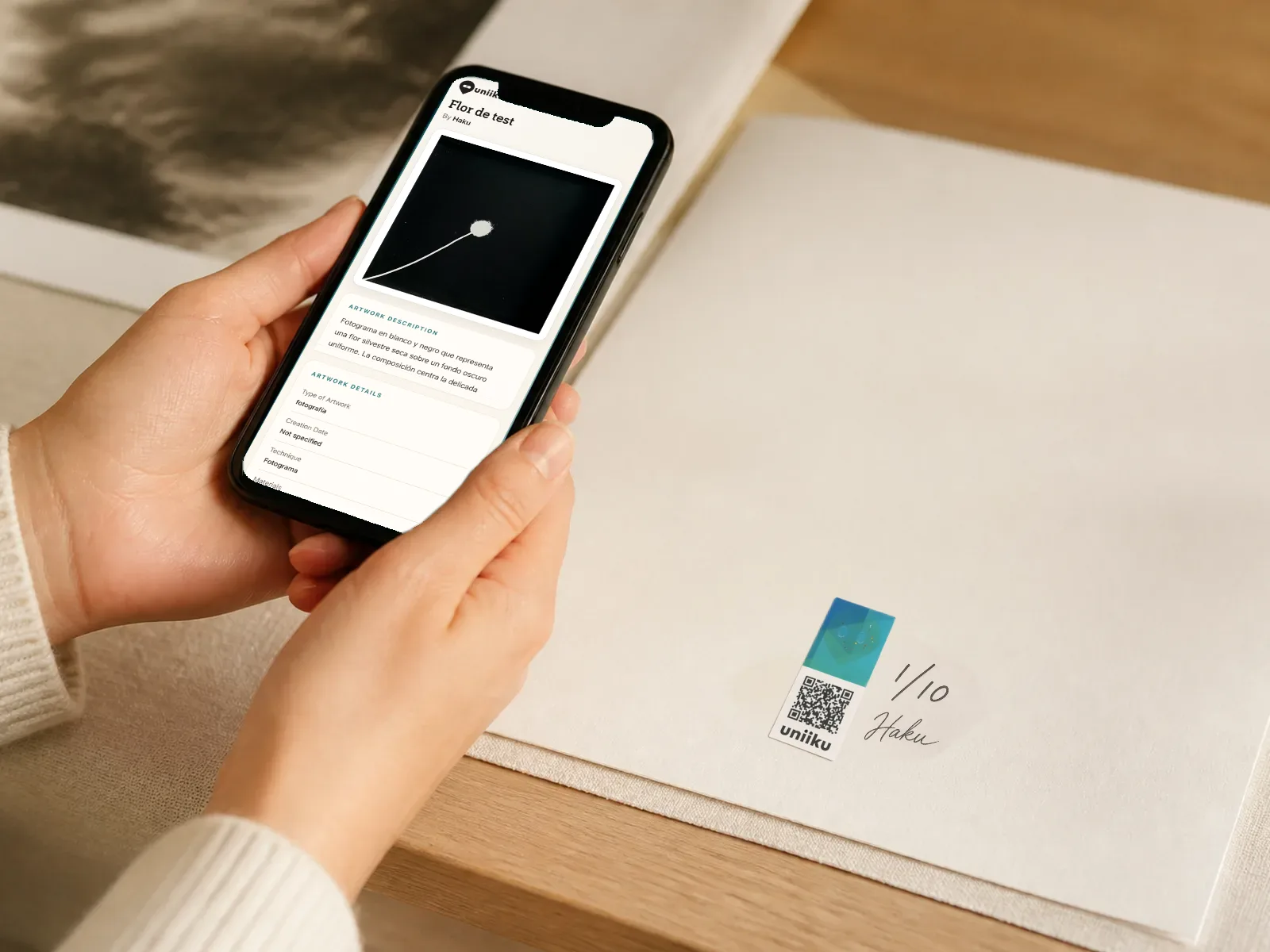
- The digital certificate holds the truth: A QR code connects immediately to the immutable technical sheet, registered with a timestamp.
- No duplication: If the seal is peeled off, it breaks and stops working. Two seals cannot be associated with the same work, and the certificate cannot be cloned.
Blockchain does not replace the canvas: it seals the moment and the content of the certificate. The seal binds that certificate to the material. Verification closes the loop for galleries and collectors.
Criteria that actually matter in a physical-digital certificate
A useful system for physical art should meet, at minimum:
- Material linking: the seal or conservation support travels with the work.
- A catalog record: title, technique, measurements, images, and coherent status.
- Frictionless verification: scan with a camera and browser, with no mandatory apps or gas fees.
- Impartial notarization: timestamp and data integrity through blockchain as notary, not as a speculative product.
- Commercial readability: the collector understands what they are checking in under a minute.
If a system fails on linking or on simple verification, it does not matter how advanced the chain is: it does not protect physical art in practice.
Mini-case: the oil painting with an NFT… and the buyer who asked to scan the canvas
An artist sold an oil painting accompanied by an “authenticity” NFT. Months later, the buyer wanted to insure the piece and the insurer asked for verifiable documentation of the object, not of the token. The metadata link pointed to an image; there was no seal on the stretcher and no certificate with comparable measurements.
The artist rebuilt the process the other way around: registered the work in their catalog, completed the technical sheet with front and reverse photos, and associated a physical seal with the stretcher. Verification became a QR on the real piece; blockchain remained the notary of the certificate, not the product being collected.
The original NFT stopped being the central proof. What convinced the insurer — and later a second interested buyer — was the ability to match the physical object with a verifiable certificate.
Why collectors prefer physical-digital certification
Traditional art buyers and galleries have shown resistance to crypto wallets, network fees (gas fees), and crypto-market volatility.
What a collector asks for is simplicity and assurance:
- Being able to scan the work with the phone camera without installing complex apps.
- Checking that the registration date matches the artist's trajectory.
- Having an authenticity assurance that keeps its value in the secondary market.
In other words: they want to verify the piece in front of them, not learn how to custody a wallet in order to understand a certificate.
Related articles
The Certificate as ID
Why the market demands immutable documentation.
Requirements of a Valid Certificate
What a collector should check to avoid fraud.
QR, NFC, and hologram seals
Physical markers versus a seal bound to the record.
Certificate providers compared
Price, who issues, copy-proof seal, data permanence, and resale.
Frequently asked questions
Does Uniiku's system require a crypto wallet or buying cryptocurrency?
No. Uniiku manages sealing technology and data integrity transparently. For the artist and the collector it works as a scan accessible from any web browser.
Can a Uniiku catalog become a Phygital certificate?
Yes. You can document all your works on the platform for free and, when you decide to certify a physical piece, associate a Uniiku physical seal with it.
Does it make sense to keep an NFT if I already certify the physical work?
Only if the NFT provides a clear digital use and is not presented as a substitute for the object's certificate. For the physical market, the main proof should be the seal, the certificate, and verification of the real piece.
Protect the real presence of your art
Link your physical works to their immutable digital identity. No network fees or crypto friction.